Philippine consumer loan defaults are climbing. The numbers behind that trend raise a harder question than most lenders are asking. This piece breaks down what the 2025 data actually shows, why broader credit data coverage has not brought delinquency down, and where the gap in credit risk assessment actually lives.
NPL Rates Are Up. Credit Data Has Never Been Wider. These Two Facts Belong in the Same Sentence.
In the first half of 2025, consumer loans across Philippine banks hit ₱3.4 trillion, a 21.2% jump in a single year, faster than the year before (Bangko Sentral ng Pilipinas [BSP], 2025a). Credit cards drove nearly 40% of that growth. BNPL platforms and personal loan apps added ₱853 billion in bookings in 2024, up 16% year-on-year (Magsino, 2025).
On the surface, that reads as progress. More Filipinos accessing credit. More financial activity in the system.
But look at what is happening on the other side.
By end-2025, the consumer loan NPL ratio had reached 5.4%, with non-performing loans most concentrated in credit card receivables, per the BSP's Second Semester 2025 Report on the Philippine Financial System (BSP, 2026). The overall banking system NPL ratio was 3.1% at the same point. Consumer lending was growing faster than total loan growth and generating a disproportionately higher share of defaults.
The gap between those two numbers is where the real story sits.
John Harley Chan, Chief Analytics Officer of CIBI Information, the analytics arm of the Credit Information Corporation, said this plainly at an industry event in August 2025:
"The delinquency rates that we see in this segment are really high. It's double-digit across the board." (Magsino, 2025)
At the time, the CIC database held 66 million borrowers and 413 million tradelines (Magsino, 2025). Credit data coverage in the Philippines has never been broader. And the fastest-growing segment was defaulting at double-digit rates.
More data. More defaults. That relationship deserves a closer look.
Why More Credit Data Is Not Closing the Gap
This is the question worth pressing on. The CIC now tracks 66 million borrowers. Multiple credit bureaus, alternative data providers, and behavioral scoring models are active in the Philippine market. Credit data infrastructure has never been more developed. So why are delinquency rates in the fastest-growing segment running in double digits?
The answer is structural, not technical. Every data source used in a traditional credit decision draws on records of what already happened. These models are well-built and genuinely predictive for borrowers with established histories. Their limitation is not quality. It is what they were designed to measure.
Every model currently in use was built to read the past. None of them were built to read what is present at the moment of application.
For borrowers with long, clean credit histories, this is rarely the problem. For the millions of Filipinos entering the formal credit system for the first time, with thin or no records, the historical model has almost nothing to read. The approval that follows is not a decision based on data. It is a calibrated guess.
And the defaults show what those guesses look like at scale.
The Signal That Already Exists at Onboarding
Here is something worth noting: lenders are already capturing data at the point of application that their credit models never use.
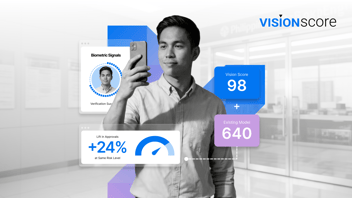
During digital onboarding, a real-time biometric signal is collected as part of standard identity verification. It happens in every application. Liveness checks, age estimation, and environmental cues are captured, used to confirm the applicant's identity, and then set aside. The credit risk information those signals carry has never been extracted.
That is the gap Vision Score was built to fill.
Vision Score, part of Trusting Social's TrustINSIGHT suite, uses computer vision models validated on over 1 million real-world outcomes to read those onboarding signals and generate an independent credit risk score of 0 to 100. It runs via API within a lender's existing workflow. Nothing changes for the borrower. The lender gains a risk layer built from data that was always there but never used for credit assessment.
As a standalone signal, Vision Score achieves a minimum 30% Gini coefficient. It does not replace any existing model in your scoring stack. It adds an independent signal grounded in the present moment of application, the one data category that historical models were never designed to reach.
For thin-file borrowers with little or no credit history, it produces a risk score where existing models currently return nothing usable.
For borrowers whose historical record appears clean but who carry risk that past data cannot surface, it provides a second, independent read from a different data source entirely.
The Question Every Credit Risk Team Should Be Asking
Philippine consumer lending is growing at its fastest recorded pace. Credit data coverage is the widest it has ever been. And delinquency rates in the fastest-growing segment are running in double digits.
How many of the loans your institution approved last year were based on real signal, and how many were the model's best guess on a borrower it barely knew?
The defaults are not coming from the borrowers your model knows well.
They are coming from the ones it never really knew at all.
Why are loan defaults rising in the Philippines despite broader credit data coverage?
The fastest-growing borrower segment consists largely of first-time digital lending users with no formal credit history. Standard scoring models have very little data to read for these applicants. Combined with declining household savings rates and inflation pressure on household budgets in 2025, this creates a structural gap between what models can assess and the actual risk in the portfolio.
What is the consumer NPL ratio in the Philippines in 2025?
The overall banking system NPL ratio was 3.1% at end-2025 (BSP, 2026). The consumer lending segment ran at 5.4%, with non-performing loans most concentrated in credit card receivables. Consumer lending was growing faster than total loans and producing a disproportionately higher share of defaults.
What is a thin-file borrower and why does it matter for Philippine lenders?
A thin-file borrower has little or no formal credit history. The World Bank's Global Findex 2025 found that 49.8% of Filipino adults are unbanked or hold no formal financial account, meaning nearly half the population is effectively invisible to traditional scoring models. As digital lenders onboard these borrowers at scale, the risk assessment gap widens.
How does Vision Score work with existing credit models?
Vision Score reads biometric signals captured during digital onboarding and returns an independent credit risk score via API. It runs alongside existing bureau scores and other data sources in your stack. It does not replace them. It adds an independent signal from the point of application, the one data category that historical models were not built to read.
ASEAN+3 Macroeconomic Research Office (AMRO). (2026, March 25). Philippines' consumer credit surge: A test the system is passing, for now. https://amro-asia.org/philippines-consumer-credit-surge-a-test-the-system-is-passing-for-now
Bangko Sentral ng Pilipinas. (2025a, November 8). Banks ramp up consumer lending on strong demand. As reported in Philstar.com: https://www.philstar.com/business/2025/11/08/2485531/banks-ramp-consumer-lending-strong-demand
Bangko Sentral ng Pilipinas. (2025b). Consumer Expectations Survey: Q3 2025. https://www.bsp.gov.ph/Lists/Consumer%20Expectation%20Report/Attachments/24/CES_3qtr2025.pdf
Bangko Sentral ng Pilipinas. (2026). Report on the Philippine financial system: Second semester 2025. As reported in BusinessWorld Online: https://www.bworldonline.com/banking-finance/2026/05/08/748253/philippine-banking-sector-to-see-limited-direct-impact-from-war/
Magsino, A. M. C. S. (2025, August 13). Digital lending boom drives growth in PHL credit data. BusinessWorld Online. https://www.bworldonline.com/banking-finance/2025/08/13/691116/digital-lending-boom-drives-growth-in-phl-credit-data/
TransUnion Philippines. (2025, December 11). Q4 2025 Consumer Pulse Study. As reported in BusinessWorld Online: https://www.bworldonline.com/banking-finance/2025/12/12/718219/filipinos-more-cautious-about-finances-as-expenses-rise-transunion-study-shows/
World Bank. (2025). The Global Findex Database 2025: Connectivity and financial inclusion in the digital economy. https://www.worldbank.org/en/publication/globalfindex/report