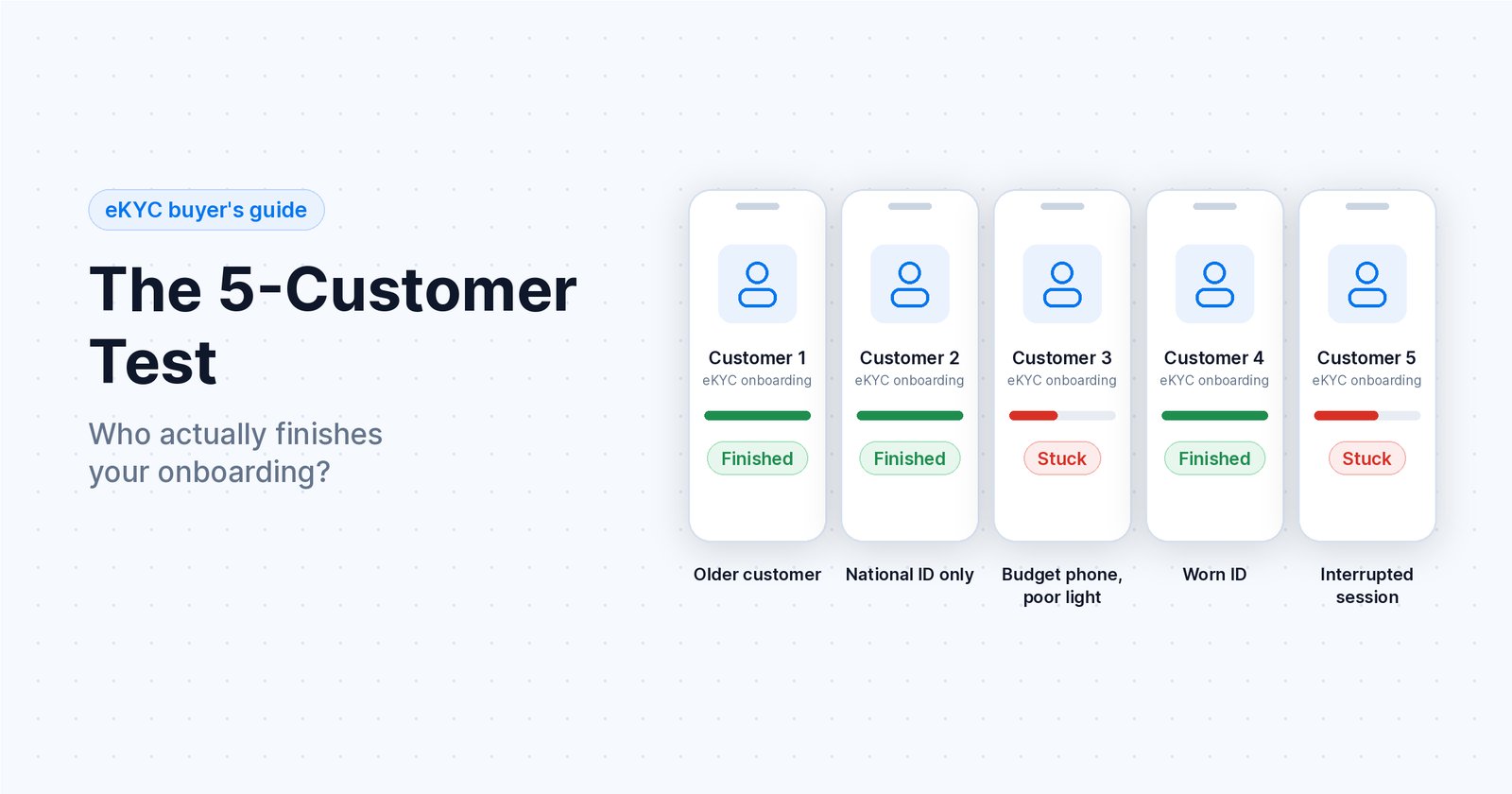
If you've sat through a few eKYC demos, you know how they go. The ID is crisp, the lighting is good, the selfie passes in two seconds, and then comes the slide with an accuracy rate somewhere above 99%.
None of that is wrong. It just isn't what your customers look like.
Real applicants sign up late at night after work, on whatever phone they have, holding an ID that's been through a few years in a wallet. Most get through. Some don't, and they almost never tell you why. They just close the app.
An accuracy rate can't show you those people, because it's measured on the ones who made it to the end. What you want to know is how many of the people who started actually finished. That's your completion rate, and it's the number we think should drive your choice of eKYC provider in the Philippines.
Last updated: November 2026.
First, know where you're losing people
Before you look at anyone's product, look at your own onboarding. Most teams can tell you their approval rate off the top of their head. Far fewer can tell you which step loses the most applicants, and that's the one that matters.
Count how many people reach each step. It doesn't need to be fancy:
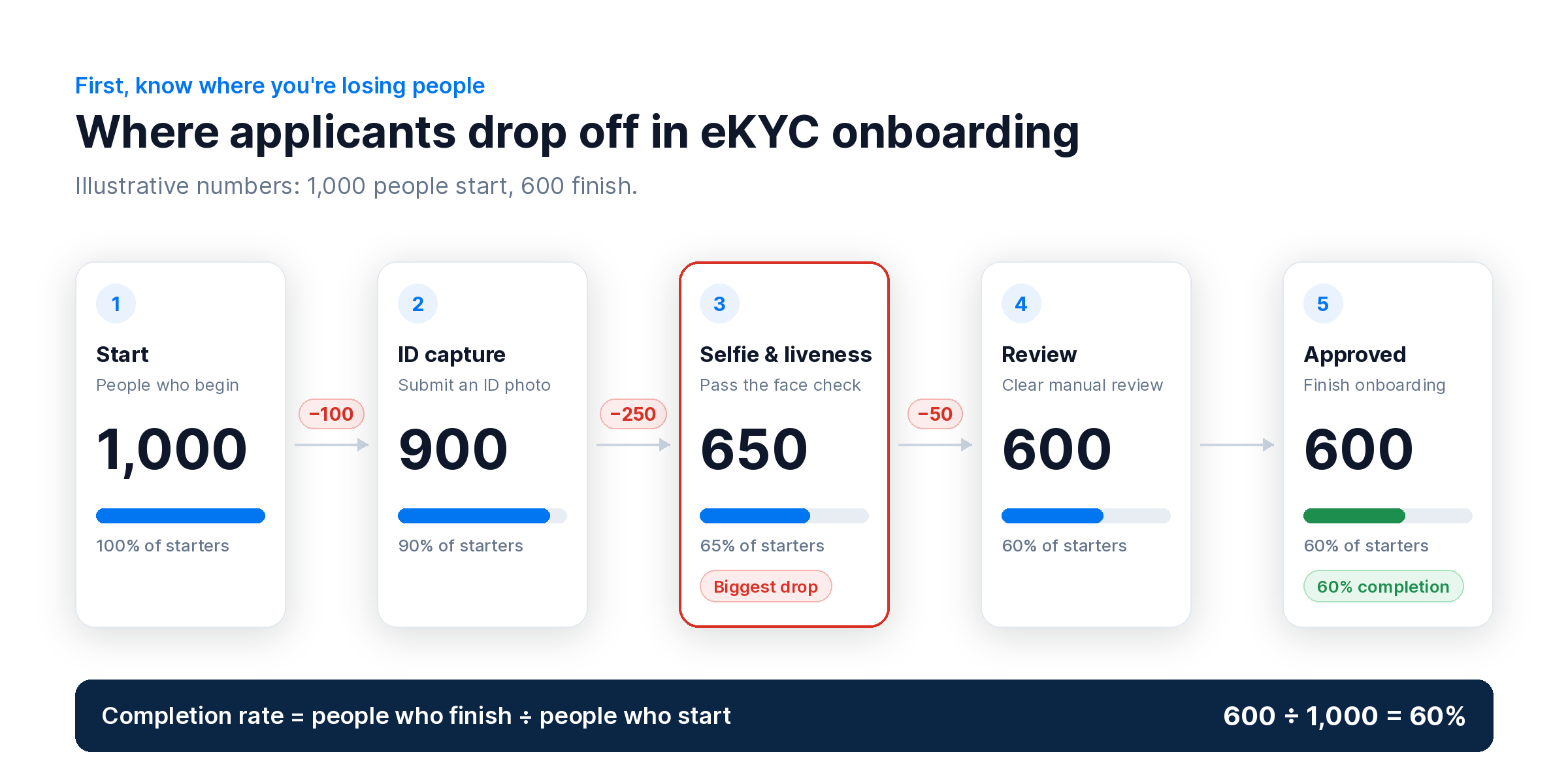
Say 1,000 people start and 600 finish. That's a 60% completion rate (illustrative numbers). If 250 of the 400 you lost dropped off at the selfie, you already know where to focus, and which step to push hardest when you test providers.
Write these numbers down. Everything that follows is measured against them.
The 5-Customer Test
This is the part we'd most like you to take away. You don't need a vendor to run it, it takes less than an hour, and it will tell you more than most demos.
The idea is simple: go through onboarding as five people who look like your actual customers, and see who makes it.
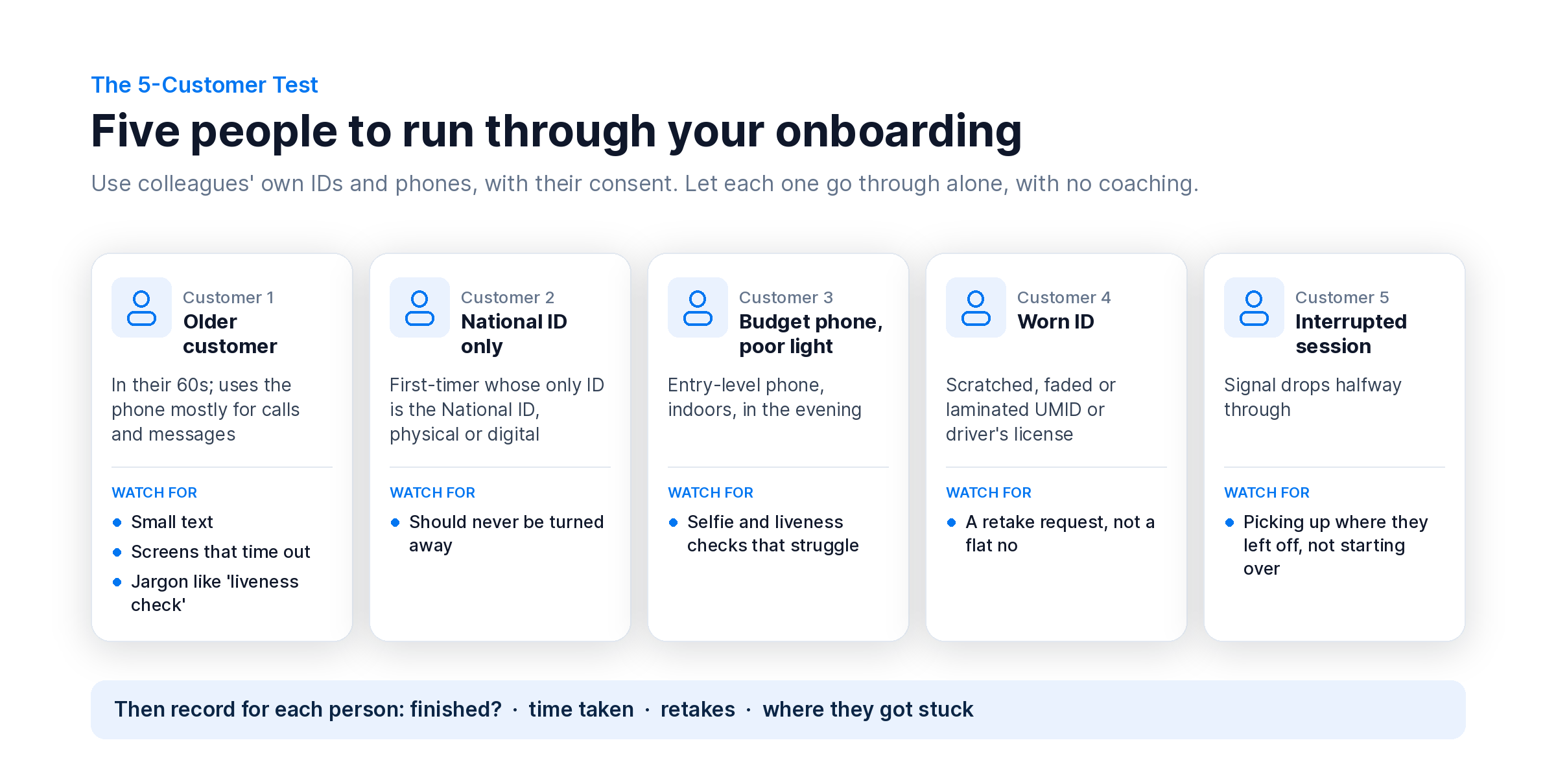
The first is an older customer, someone in their 60s who mostly uses their phone for calls and messages. Watch for small text, screens that time out too fast, and instructions that assume they know what a "liveness check" is.
The second is a first-timer whose only government ID is the National ID, in physical or digital form. The BSP has asked banks to treat the National ID as the top acceptable ID (Philstar), so this person should never be turned away.
The third is someone on a budget phone, indoors, in the evening. Entry-level cameras and dim rooms are where selfie checks tend to struggle.
The fourth has a worn ID: a UMID or driver's license that's scratched, faded or laminated. You're watching for whether the system asks for a retake or just says no.
The fifth is the interrupted session. Their signal drops halfway through. Can they pick up where they left off, or do they have to start over?
Ask colleagues to volunteer their own IDs and phones (with their consent, and never with real customer data). Let each person go through on their own, no coaching. Then fill this in:
Run it on your current setup first, then on every provider you're considering. If even one of the five can't finish, you've found a group of customers your onboarding is quietly turning away.
What happens after a failed check matters more than you'd think
You'll hear a lot about testing the "exception path", meaning what your team sees when verification fails. Fair enough. But the screen your customer sees in that moment matters just as much, because that's where they decide whether to try again or give up.
"Verification failed" with nothing else is a dead end. "Your photo is a bit dark. Try moving closer to a light and take it again" usually gets a second attempt. Same failure, very different outcome.
A few things separate a good second chance from a bad one. The customer should be told what went wrong in plain language. They should have another way forward, whether that's a retake with tips, a different ID, or the option to come back later without losing what they've already entered. If they keep failing, there should be a person they can reach. And if their application goes to manual review, someone should answer within a reasonable time, because a customer who waits days will often sign up somewhere else.
When you run the 5-Customer Test, screenshot every error message you hit. Then ask yourself whether your own parents would know what to do next.
National ID authentication is coming, so ask about it now
Whoever you choose today will probably still be running your onboarding when the next rule lands.
In August 2026, the BSP released a draft that would have supervised institutions verify customers through the PSA's National ID Authentication Services when they open or update accounts, whether online or in a branch (Biometric Update; BusinessWorld). When we last checked, it hadn't been issued as a final rule.
If it goes through as drafted, retail banks, digital banks, e-money issuers and virtual asset service providers would have three months from issuance, and thrift, rural and cooperative banks and other supervised institutions six months from effectivity. Other IDs would still be acceptable on a risk basis when a customer has no National ID or the service is down, and a physical or printed National ID wouldn't be needed when identity is confirmed through the service.
So it's worth asking every provider three things now: can you connect to the PSA's authentication service, and when? What does the customer see if the service is unavailable or they don't have a National ID yet? And will this mean a second integration project for us later?
What to ask in your next eKYC vendor meeting
If you only bring one thing into the room, bring this.
On checks that match the risk: the BSP's eKYC rules expect tiered, risk-based policies (Context.ph), so a provider that can't adjust by product makes your life harder. On faces and fraud, onboarding checks deserve their own look. Our guide to choosing a fraud prevention provider goes into that. And on privacy, remember you stay accountable for customer data under the Data Privacy Act of 2012, no matter who processes it.
Where we stand
We've built onboarding for Philippine lenders since 2019, and our models have scored more than 110 million Filipino consumers. If there's one thing that work has taught us, it's that a bad photo is not a bad customer.
That belief is built into TrustVision Customer Onboarding. It reads Philippine IDs, matches the face and checks liveness in one step, and asks for a retake rather than declining a poor photo. E-signing and optional AML screening can run in the same flow. If you're curious how the ID checks work behind the scenes, we wrote about how lenders verify Philippine IDs online.
Your next step
Run the 5-Customer Test on your own onboarding this week. Whatever provider you use, you'll come away knowing exactly which customers you're losing and why.
Related reading: How to Choose a Fraud Prevention Provider in the Philippines · The Deepfake Dilemma: Why Liveness Detection Decides Who Gets In · What AFASA Has Changed So Far
This article summarises public sources and is not legal advice.
Sources
- Context.ph. (2023, April 3). BSP issues new rules on customer due diligence, e-KYC. Link
- Liang, L.-H. (2026, August 11). Philippines pushes national ID as foundation for financial identity verification. Biometric Update. Link
- Chan, K. K. (2026, August 7). BSP wants banks to use National ID authentication in KYC processes. BusinessWorld. Link
- BSP to banks, financial institutions: Prioritize national ID as top identification. (2024, March 13). The Philippine Star. Link
- Republic Act No. 10173. (2012). Data Privacy Act of 2012.