In an era of industrialized deception, your biggest risk isn't a bad credit score—it’s a flawless face that doesn’t exist.
For years, the financial industry has played a game of "detect the deviant." We’ve been conditioned to look for the outlier—the customer with a history of defaults or the sudden, suspicious transaction. But what if the most insidious threat is the one that leaves no trail?
The most dangerous fraudster isn't always a person. Increasingly, it is a meticulously crafted Deepfake—a digital ghost with a perfect social footprint, no red flags, and a face that can bypass a biometric gate in milliseconds. We are no longer just fighting stolen data; we are fighting the democratization of high-fidelity forgery.
The Era of Industrialized Deception
The technology behind this shift didn't just appear; it evolved from academic curiosity to a weapon of choice. While the term "deepfake" was coined in 2017, we have reached a tipping point where generative AI has made hyper-realistic audio and video accessible to nearly anyone.
This isn't just about "faking" a photo. It is about a sophisticated Presentation Attack, where a criminal uses synthetic media to impersonate a live person during a real-time interaction. The stakes are staggering: identity fraud rates in APAC have surged as deepfakes become the primary vehicle for bypassing Know Your Customer (KYC) protocols. In the Philippines alone, deepfake-related fraud attempts have reportedly increased by 4,500%, signaling an era where digital literacy can no longer keep pace with digital deception.
The $25 Million Lesson
The industry "cringe" moment happened when a multinational engineering firm, Arup, lost $25 million because an employee believed they were on a video call with their CFO. In reality, every other participant on that call was an AI-generated deepfake.
Closer to home, prominent Filipino leaders have been forced to go on the offensive. Jaime Augusto Zobel de Ayala and Ramon Ang have repeatedly issued public warnings against sophisticated investment scams using their cloned voices and likenesses to lure victims into fraudulent schemes.
If a human eye can be fooled by a CFO’s voice, your security systems are the final line of defense. And if those systems rely on a single face match or a basic liveness check, they are already a step behind.
Deepfake Fraud Detection Starts With Liveness
Trust is a social contract that requires a modern heartbeat. To survive this shift, institutions must move from Observation to Validation. The solution isn't just looking at a face; it’s about verifying liveness—proving that the entity on the other side of the camera is a real, present human, not a photo, a replay or a synthetic face.
The TrustVision Advantage
This is where the arms race is won. At Trusting Social, we don't rely on manual spot-checks. TrustVision was built by a research team that includes 20+ PhDs and 80+ Master of Science professionals in data science and AI, and its liveness detection is certified to ISO/IEC 30107-3 (iBeta Level 1 and Level 2), the international standard for presentation attack detection.
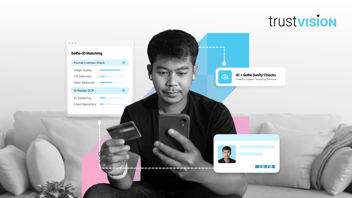
Instead of a binary match, TrustVision layers several checks in real time:
- Edge Liveness: A gesture-based check built to feel as easy as a passive one, it stops printed photos, screen replays and masks at onboarding, before an account is ever opened.
- Deepfake and Tamper Detection: TrustVision deepfake detection flags synthetic faces, presentation attacks and forged or tampered IDs.
- Face Retrieval: Every new face is checked against a database of known fraud attempts, so a face that has already appeared under another name is caught—one of the clearest signs of synthetic identity fraud.
Moving Beyond the Snapshot
The deepfake dilemma is a reminder that in a digital-first economy, trust is not a static asset. It is a living signal. Relying on outdated, manual processes is like using a paper map in a city that changes every hour; by the time you realize the path is wrong, the opportunity (or the money) is already gone.
That is why liveness shouldn't happen only once. The same check can come back at high-risk moments—large transfers, new payees, device changes—through face-based transaction verification, a shift we explain in The End of the OTP.
Securing the human journey now requires an intelligence that is as adaptive as the threats it faces. It’s no longer about building higher walls; it’s about having the clarity to know exactly who is standing at the door.
Where to Start
Curious how your current liveness check holds up against today's deepfakes? Talk to our team and bring your hardest case.