
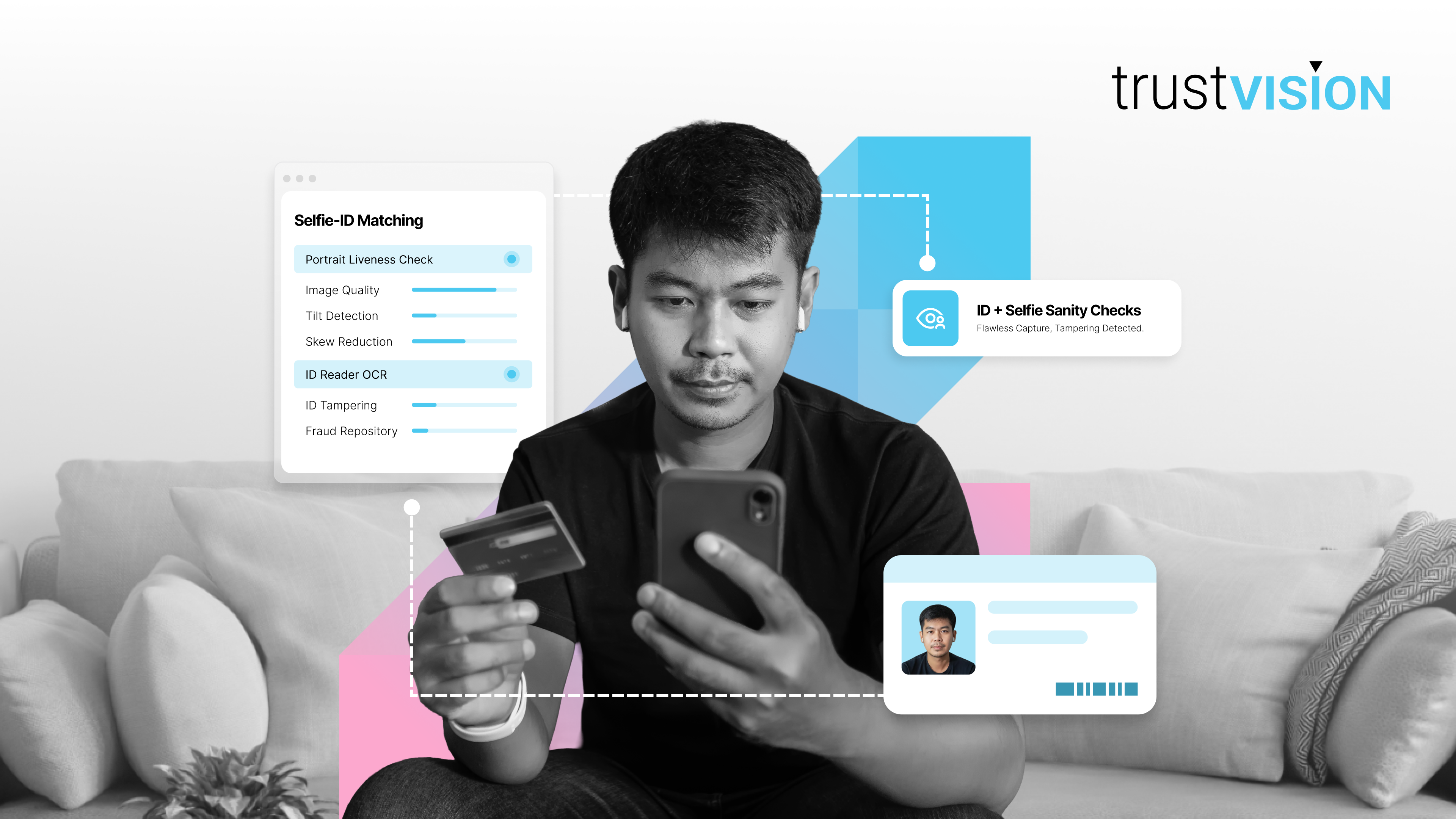
In this piece. TrustVision is Trusting Social's digital onboarding and fraud prevention platform, and it is built in three layers, not one: identity verification at onboarding, fraud prevention that authenticates the document and cross-checks it against a shared fraud database, and transaction verification that replaces OTPs with the customer's own face. Here is what each layer does, and how they work as one system instead of three separate tools.
One capture, three jobs
A customer opens your app, photographs an ID, and takes a selfie. Most institutions treat that moment as solving one problem: confirming the customer is who they say they are.
TrustVision reads three problems out of that same capture. It verifies the customer is real. It authenticates the document and checks the face against every other face already on file. And it registers that same face so it can be used later, at the exact moment a transaction needs proving instead of a one-time SMS code.
That is what makes TrustVision one platform rather than three point solutions stitched together: one capture, one API, three layers of protection that build on each other instead of duplicating each other.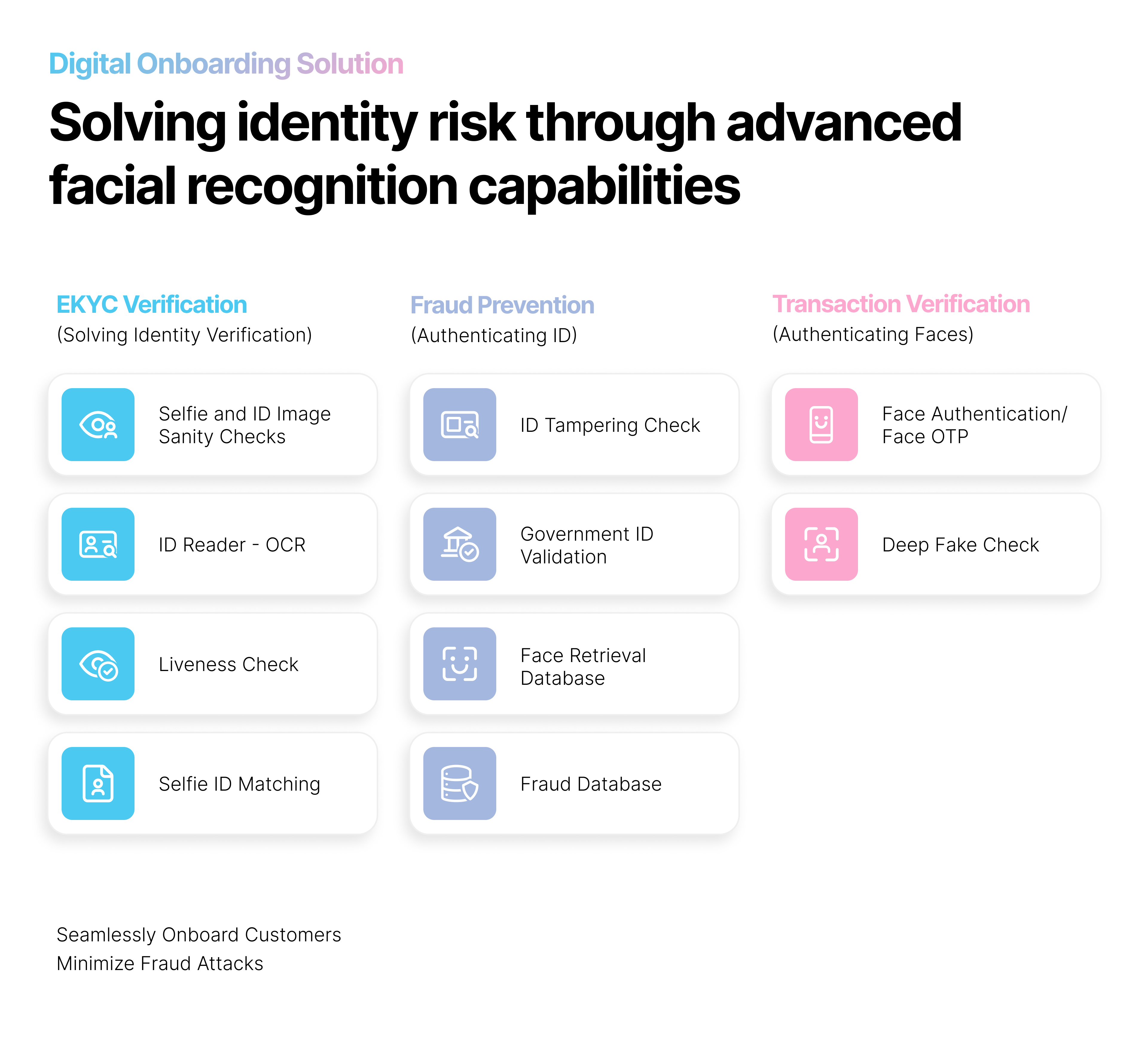
The three layers
Layer 1: Onboarding — solving identity verification.
Three checks run on the ID and selfie at signup: image quality checks that catch blur, tilt, and the wrong document before a customer is wrongly declined; OCR that reads and extracts data across 10 Philippine government IDs; and a liveness check, certified to ISO 30107-3 Level 2, that confirms a real person is present rather than a photo or a deepfake. This is the layer that determines whether a genuine customer's application makes it through in the first place.
→ Read the full onboarding breakdown
Layer 2: Fraud Prevention — authenticating the ID.
Where onboarding confirms a real person is present, this layer asks a harder question: is the document trustworthy, and has this face already applied under a different name. It scans for more than 20 signs of ID tampering, validates documents against government sources, and checks new faces against a database built from an institution's own KYC images. It also connects to Suspicious Face Alert, a cross-institution fraud database built around BSP Circulars 1213 through 1215, so fraud caught at one bank can be flagged before it reaches the next.
→ Read the full fraud prevention breakdown
Layer 3: Transaction Verification — retiring the OTP.
The face registered at onboarding becomes an ongoing authentication tool, replacing SMS codes for logins, transfers, withdrawals, and branch transactions. Because a face is something you are rather than something you hold, it closes the SIM-swap and OTP-interception gap that possession-based authentication has always had, and it is built to roll out to an existing customer base in phases rather than all at once.
→ Read the full transaction verification breakdown
Why this is one platform, not three vendors
Institutions evaluating eKYC, fraud prevention, and authentication separately usually end up integrating three different vendors, three different SDKs, and three different data pipelines that do not talk to each other. TrustVision's advantage is structural: all three layers read from the same registered face and the same capture, connect through a single API, and are managed through one dashboard, TrustCentral, for institutions that want a low-code path. Both SaaS and on-premise deployment are supported across all three layers.
This also means the layers compound. A face registered during onboarding is what makes transaction verification possible later without asking the customer to enroll twice. A face flagged as suspicious by the fraud prevention layer is what the Suspicious Face Alert network shares with other institutions. None of the three layers is only useful on its own; each makes the others more effective.
By the numbers
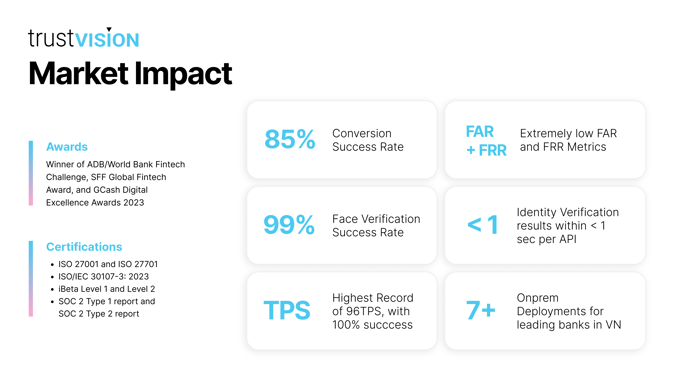
TrustVision has processed more than 200 million eKYC checks in 2024 alone, across 82+ financial institutions in the Philippines, and holds the #1 position in deepfake prevention across Vietnam and the Philippines. It holds ISO 27001 and ISO 27701 certification, ISO/IEC 30107-3:2023 (iBeta Level 1 and Level 2) for liveness, and both SOC 2 Type 1 and Type 2 reports, alongside the ADB/World Bank Fintech Challenge, the SFF Global Fintech Award, and the GCash Digital Excellence Award in 2023.
What TrustVision is, and what it isn't
It is a combined eKYC, fraud prevention, and transaction authentication platform, built on one biometric capture and one registered face, deployable through a single API.
It is not a credit scoring tool. Whether a customer is a good credit risk is a separate question, one that TrustInsight products like Vision Score are built to answer using an entirely different kind of signal from a different point in the lending process.
The bottom line
Most institutions solve identity, fraud, and authentication with three separate vendors that never share a signal. TrustVision solves all three from the same capture, which is the difference between three tools and one system.